
Our Journey
Not every problem
is easy to see.

The biggest nutritional challenge isn’t always a lack of food. Sometimes, it’s a lack of the right nutrition.
Chapter one
The journey that changed everything.
As part of her research at the Indian Institute of Technology Bombay (IIT Bombay), Shruti Mehta travelled to tribal communities across India to better understand everyday food practices and nutritional challenges.
She met families who cooked fresh meals every day. Their plates were colourful. Their diets reflected local ingredients, traditions and familiar ways of eating. Yet many communities continued to experience hidden hunger — a form of undernutrition in which people may consume enough food but still lack adequate essential nutrients.
The experience challenged a common assumption. The issue wasn’t always access to food alone. It was also the nutritional quality of the food being consumed. That question stayed with her long after she returned.

Chapter two
Looking beyond empty plates.
Most conversations about nutrition focus on hunger. But what Shruti witnessed was different.
- Families were eating.
- Children were eating.
- Meals were being prepared every day.
- Yet nutritional gaps remained.
The experience led her to look beyond the question of whether people were eating enough. She began asking a more fundamental question: how could everyday meals become more nourishing without asking people to change the food they already knew, loved and trusted?
The answer, she realised, could not depend on a solution that was difficult to afford, inconvenient to use, or disconnected from the way people actually ate. The challenge was not simply to develop something nutritious. It was to develop something that could realistically become part of everyday life.
The solution wasn’t to replace food. The solution was to make everyday food more nutritious.
Chapter three
Looking for a solution that could last.
As part of her research at the Indian Institute of Technology Bombay (IIT Bombay), Shruti explored existing nutrition solutions, including supplements and plant-based products.
While these products can serve important purposes, she recognised that affordability, long-term use and everyday practicality were important considerations.
She also wanted to look beyond the nutrients present in a product to understand how those nutrients could become available for the body to absorb and utilise. Plant-based ingredients can offer valuable nutrition, but certain naturally occurring compounds may influence the availability of some nutrients.
This led her to explore a food-based approach that considered not only the nutritional contribution of carefully selected ingredients, but also the factors that can influence nutrient availability.
Her aim was to develop a solution that brought together nutritional value, practicality and accessibility — one that could fit into familiar meals rather than require people to change their eating habits.

Chapter four
One country, many food cultures.
India does not eat just one way.
Food changes from state to state, district to district, and household to household. The ingredients available in one region may differ from those found in another. Cooking methods, flavours, textures and meal traditions vary widely, shaped by geography, culture, seasons and generations.
A nutrition solution that depends on changing these habits risks becoming difficult to adopt. Asking every household to follow the same diet, prepare a separate meal, or consume the same preparation every day overlooks the diversity that makes India’s food culture so rich.
Shruti’s research encouraged a different way of thinking.
What if the nutrition solution adapted to people’s meals, rather than asking people to adapt their meals to the solution?
The ambition was not to create one new food habit for everyone. It was to explore a way to complement existing food habits across different communities and dietary traditions.
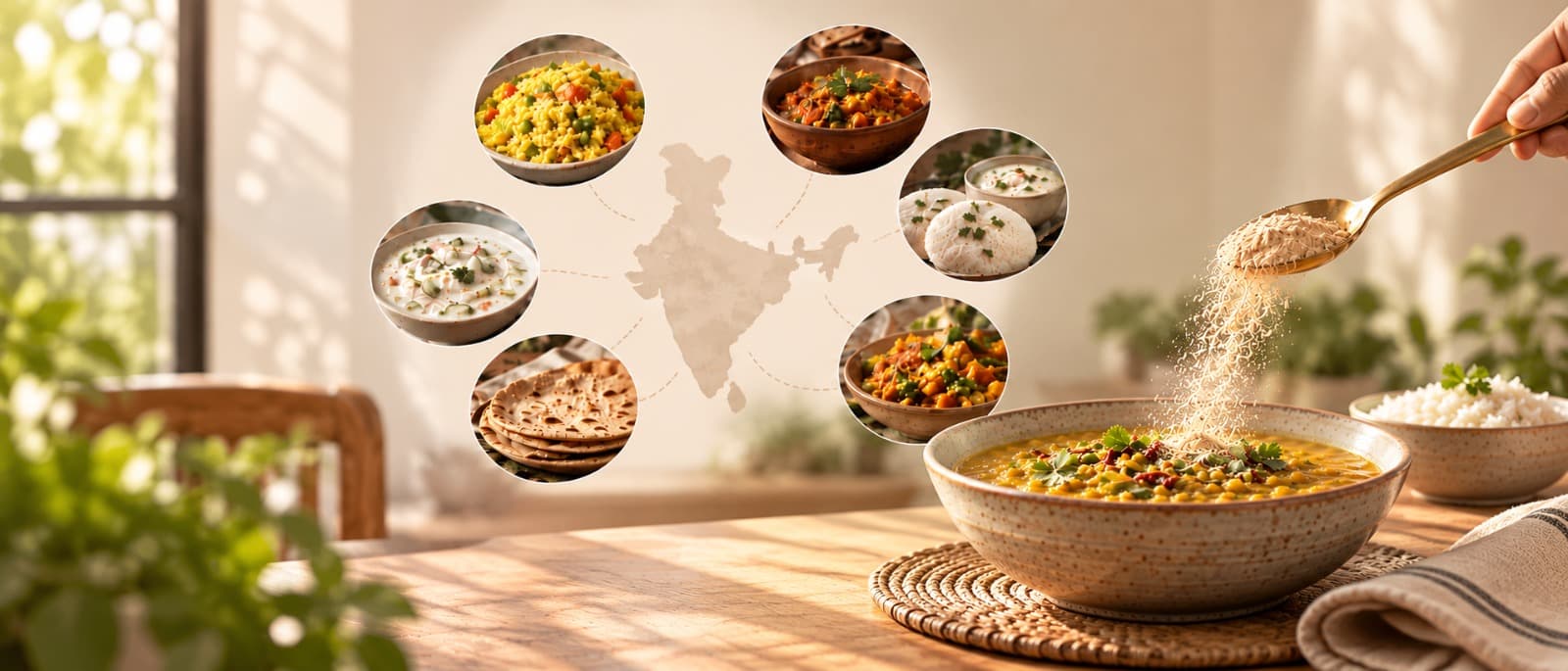
Dal, sabzi, khichdi, rice, curd and other familiar foods would remain part of the plate. The opportunity lay in developing a nutritional blend that could fit naturally into the meals people already prepared.
- Because improving nutrition should not mean giving up food traditions.
- It should mean finding ways to build on them.
Chapter five
A simple idea with a bigger purpose.
What if nutrition could be added to the meals people already prepared every day?
- Dal
- Sabzi
- Khichdi
- Rice
- Curd
- Roti
- Instead of changing food habits, could we strengthen them?
This became the guiding idea behind Shruti’s work: to explore a food-first approach that brought together carefully selected ingredients and made them usable in everyday meals.
The ambition was to bring several considerations together — nutritional contribution, accessibility, affordability, sensory acceptance and ease of use. A solution would have little practical value if people could not afford it, did not enjoy using it, or found it difficult to incorporate into their daily routines.
The idea was simple, but the research behind it was not. It required studying ingredients, understanding their nutritional characteristics, and exploring how they could be combined into a formulation designed to complement familiar foods.
This thinking became the foundation of what would later evolve into Power Sprinkle.


Chapter six
Years of searching for the right answer.
Finding the answer required patience. Through research at the Indian Institute of Technology Bombay (IIT Bombay), Shruti studied ingredients, explored formulations, and worked towards a blend that could complement everyday meals.
The challenge was not simply to combine ingredients that contained protein, fiber, healthy fats and minerals. It was also to understand how the formulation and its processing could influence the availability of nutrients for absorption.
The research considered more than the nutrients contributed by individual ingredients. It also explored the role of processing and formulation in nutrient availability and the potential for nutrients to be more accessible for absorption by the body.

The question was not just how much nutrition a blend could contain, but how those nutrients could become available for the body to absorb.
Alongside nutritional considerations, the formulation needed to be versatile and convenient enough to work with familiar foods across India’s diverse culinary traditions. It had to support the way people already cooked and ate, rather than require them to adopt an entirely new routine.
The research brought these considerations together in the development of a patented food-to-food fortification technology and, eventually, Power Sprinkle.
The patent became an important milestone in the journey. But the larger purpose remained unchanged: to explore a food-first nutrition solution that considered not only the nutrients present, but also their availability, while remaining practical for everyday use.
Chapter seven
From research to reality.
Scientific research has the greatest impact when it can translate into practical solutions.
To take the innovation beyond the research setting, InstaNutrients India Pvt. Ltd. was founded with the aim of developing research-led nutrition solutions for everyday use.
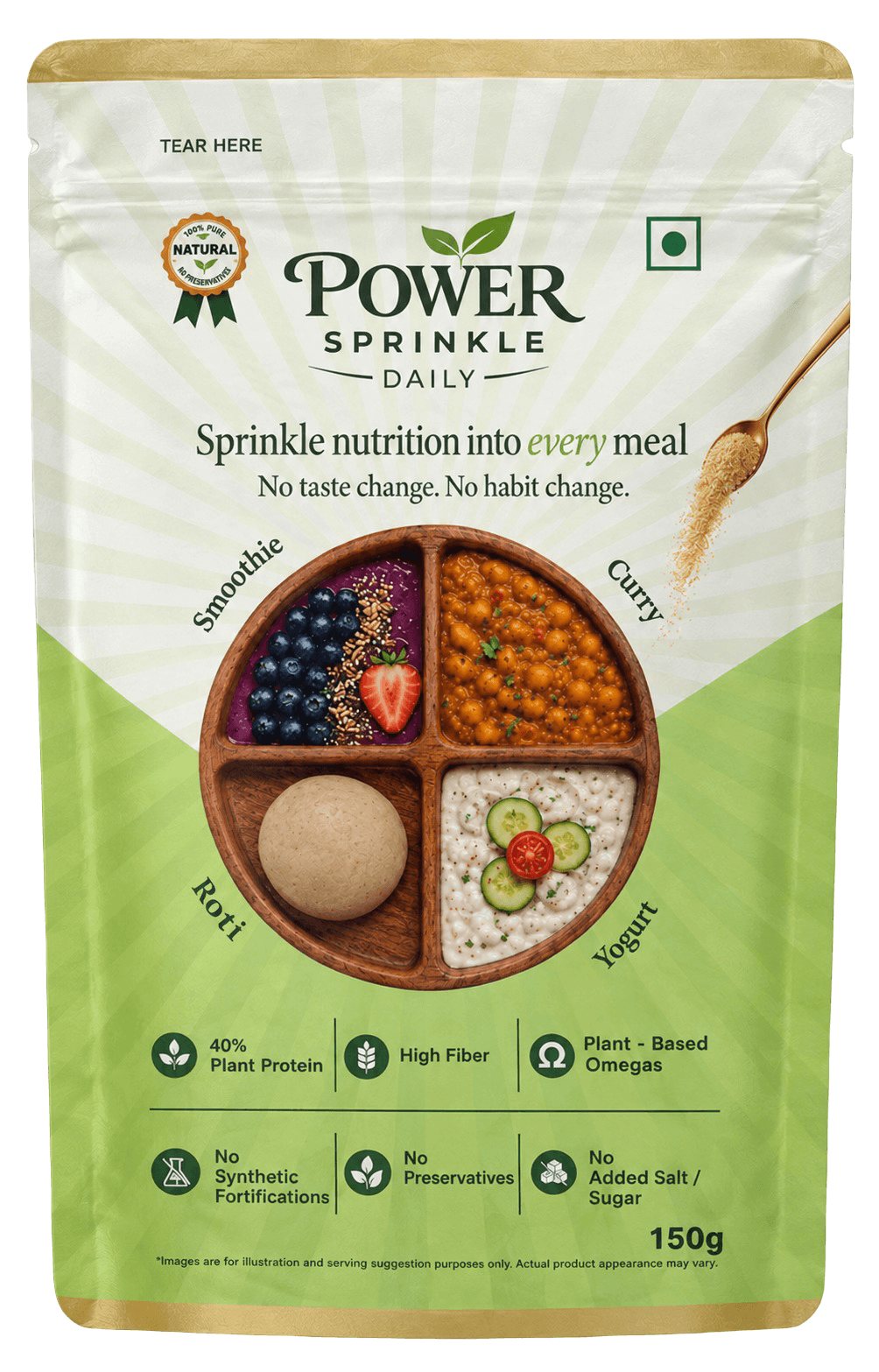
Power Sprinkle became the first step in that journey: a plant-based nutritional blend developed around the principle of food-to-food fortification.
Rather than asking families to replace familiar foods or follow an entirely new routine, it was designed to complement the meals they already prepared.
The vision was to bring research closer to the kitchen table, making the connection between scientific thinking and everyday food more tangible.
Chapter eight
The journey continues.
Power Sprinkle is one chapter in a larger journey.
The questions that inspired its development continue to guide the work ahead:
- How can nutrition become easier to access?
- How can food-based solutions work across diverse eating habits?
- How can research lead to products that are practical, affordable, and relevant to everyday life?
The answers will continue to evolve through research, learning, collaboration, and a deeper understanding of the people these solutions are intended to serve.
Because India’s nutritional needs are diverse. And meaningful solutions must recognise that diversity rather than expect everyone to eat, cook, or live in the same way.
The journey continues — not to change the way India eats, but to explore how the food India loves can become more nourishing.
A letter from Shruti
When I travelled through tribal communities, I expected to learn about food. What I discovered was something much deeper.
I met families who cared deeply about feeding their children, yet nutritional gaps remained despite the meals they prepared every day. That experience changed the direction of my research.
As I explored possible solutions, I looked at the nutrition products already available. I began thinking about whether a solution could truly become part of everyday life — not just in terms of affordability and convenience, but also in terms of the nutrition it could offer.
I wanted to look beyond simply adding nutrients or combining plant-based ingredients. I wanted to understand how the formulation could be developed with nutrient availability and absorption in mind, so that the nutritional potential of the ingredients could translate into meaningful value for the body.
I kept returning to one thought: people should not have to give up the food they know and love to improve their nutrition.
India is a country of extraordinary food diversity. What works in one household may not work in another. I wanted to explore a solution that could fit into this diversity, using carefully selected ingredients and working with familiar meals rather than replacing them.
That thinking became the foundation of Power Sprinkle.
For me, meaningful innovation begins by listening, observing and understanding people’s lives. Research matters most when it brings nutritional science closer to the needs of everyday life.
Thank you for being part of this journey.
Shruti Mehta
Founder & researcher
The research that
came out of it.
What began in the field became years of formulation work, a patent, and a blend designed for the meals people already cook.
Explore our science