
The food you already cook.
17 everyday Indian recipes,
made better with Power Sprinkle.
From soft rotis and crisp dosas to pav bhaji, pasta and a fudgy brownie: familiar family favourites, each with a clear nutrition table that shows what Power Sprinkle adds.
Every recipe below shows a nutrition table comparing the dish as it is normally made against the same dish with Power Sprinkle added, alongside the share of an adult's daily requirement each 100 g provides.
Browse the recipes
Showing 17 of 17 recipes
- MainPower Sprinkle RotiSoft Everyday Wheat Roti10 min prep15 min cook
- BeverageBanana Date Power Sprinkle MilkshakeA Naturally Sweet Morning Shake5 min prep0 min cook
- SnackPower Sprinkle CurdA Two-Minute Nutritious Curd Bowl2 min prep0 min cook
- BeveragePower Sprinkle Buttermilk (Chaas)A Cool, Frothy Refresher5 min prep0 min cook
- DessertWhole Wheat Power Sprinkle BrownieA Fudgy Whole Wheat Treat15 min prep25 min cook
- DessertSweet Sheera (Suji Halwa)A Warm, Comforting Classic5 min prep10 min cook
- MainPower Sprinkle Everyday Curry GravyOne Gravy Base for Every Vegetable10 min prep20 min cook
- BreakfastGreen Moong CheelaA Crisp, Savoury Moong Pancake8 hr soak + 10 min prep10 min cook
- BreakfastPower Sprinkle AppamA Soft, Golden, Savoury Bite5 min prep10 min cook
- BreakfastPower Sprinkle DosaCrisp, Golden and Familiar3 min prep8 min cook
- MainStuffed Capsicum (Bharwa Shimla Mirch)A Hearty Besan and Potato Masala Filling15 min prep15 min cook
- SnackShankarpaliCrisp Sweet Diamonds25 min prep15 min cook
- MainWhite Sauce PastaCreamy, Cheesy and Comforting5 min prep12 min cook
- MainRed Sauce PastaA Smooth, Tangy Tomato Sauce10 min prep15 min cook
- MainPink Sauce PastaThe Best of Both Sauces10 min prep20 min cook
- MainPav BhajiMumbai's Favourite Street Food15 min prep25 min cook
- DessertSteamed ModakThe Festival Favourite20 min prep15 min cook

About the numbers
How these figures are calculated
Each dish is calculated by adding up the nutrient content of every ingredient, allowing for what ordinary cooking removes using published retention factors, and dividing by the weight of the finished dish. Values are then expressed per 100 g (or per 100 ml for drinks) and compared against the daily requirement of a sedentary adult man. Each table states the basis used.
- Longvah, T., Ananthan, R., Bhaskarachary, K., & Venkaiah, K. (2017). Indian Food Composition Tables (IFCT 2017). National Institute of Nutrition, Indian Council of Medical Research, Hyderabad. Source of the nutrient values of the base ingredients. Where an ingredient is not tabulated in IFCT 2017, values from USDA FoodData Central (U.S. Department of Agriculture, Agricultural Research Service, Beltsville, MD) were used.
- ICMR-NIN Expert Committee (2024). Dietary Guidelines for Indians, revised edition 2024. ICMR-National Institute of Nutrition, Indian Council of Medical Research, Department of Health Research, Ministry of Health and Family Welfare, Government of India, Tarnaka, Hyderabad 500 007, Telangana, India. Available at: https://nin.res.in/dietaryguidelines/pdfjs/locale/DGI_2024.pdf. Reference individual: sedentary adult man of 65 kg on a 2000 kcal reference diet, with total fat up to 30% of energy. Source of the RDA reference values used for a sedentary adult male.
- ICMR-NIN Expert Group on Nutrient Requirement for Indians (2020, updated 2023). Nutrient Requirements for Indians: Recommended Dietary Allowances (RDA) and Estimated Average Requirements (EAR). ICMR-National Institute of Nutrition, Hyderabad. The RDA report adopted by the Dietary Guidelines for Indians 2024. Source of the RDA of protein, calcium, iron and magnesium for a sedentary adult man (reference body weight 65 kg).
- Bognár, A. (2002). Tables on weight yield of food and retention factors of food constituents for the calculation of the nutrient composition of cooked foods (dishes). Berichte der Bundesforschungsanstalt für Ernährung, BFE-R-02-03. Federal Research Centre for Nutrition, Karlsruhe, Germany. Source of the cooking retention factors (Part 2, Tables 1 and 2). Available at: https://www.fao.org/uploads/media/bognar_bfe-r-02-03.pdf.
Please note: every nutrition value on this page is approximate and calculated, not measured. The figures combine published food-composition data for the ingredients, an allowance for cooking losses using published retention factors, and the laboratory-based nutrient profile of Power Sprinkle, divided by the weight of the finished dish. No finished recipe has been analysed in a laboratory, so real values will vary with ingredient brand, variety, ripeness, portion size and cooking time. These figures are not a certificate of analysis and should not be used as the basis of a regulatory nutrition declaration.
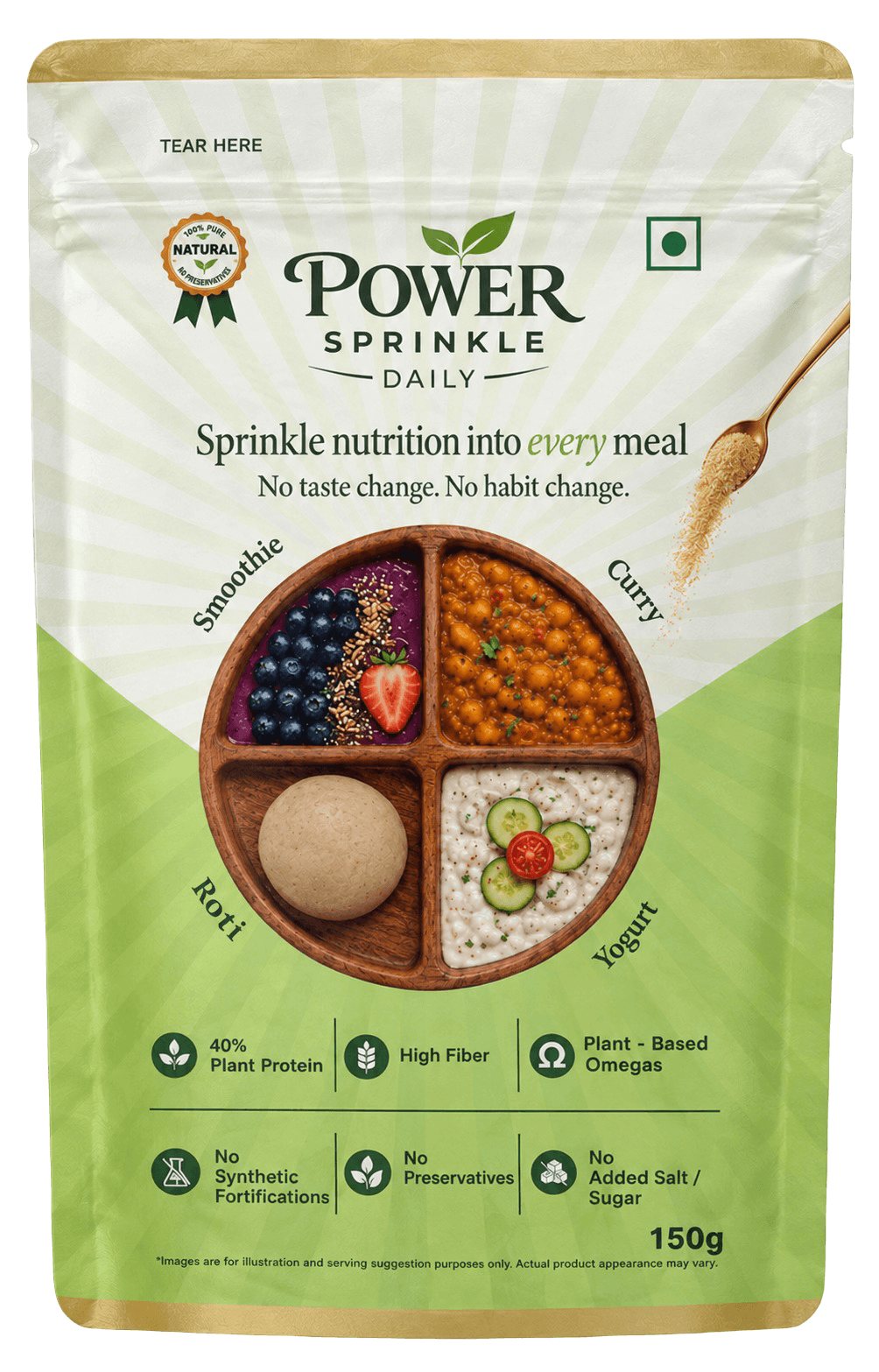
One spoon, every meal.
Five grams stirred into the food your family already eats. No new habits, no separate meal, no taste to get used to.
Buy Power Sprinkle